
Formula
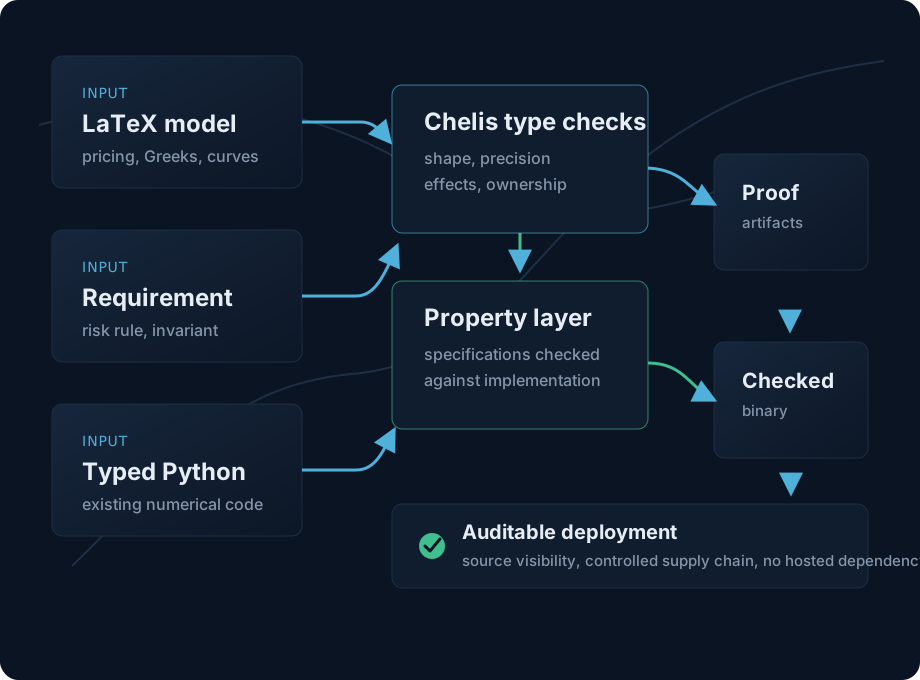
Pricing notes, risk formulas, Greeks, and curve logic become typed Chelis programs with source traceability.
See the pathHigh-stakes numerical systems
AI agents are producing more numerical code than review can absorb. C Proof moves consequential kernels from Python's runtime boundary into Chelis, a checked substrate where shape, precision, effect, and ownership rules are enforced before production. Property and proof checks bind implementations to stated specifications, with evidence your team can inspect.
Why now
A model can draft a day's worth of pricing, signal, risk, or data-transform code before a human can read one kernel closely. Python accepts too much of that ambiguity at run time, after the code has already crossed into the research or production path.
C Proof gives generated code a checked substrate. Move the consequential kernels into Chelis, keep typed constraints and specification properties in the build, and leave lower-risk Python around them while migration happens function by function.
Inputs
Pricing notes, risk formulas, Greeks, and curve logic become typed Chelis programs with source traceability.
See the pathExisting numerical functions can be translated function by function instead of replacing the research stack at once.
See the pathPortfolio constraints, risk measures, and signal rules become explicit program properties.
See the pathExplicit tensor types and pipe stages keep the numerical path visible to the type checker.
def pipeline(x: &tensor[n, f32]) -> tensor[n, f32] =
  x |> relu |> sigmoid
Checks
Chelis type rules reject shape, precision, effect, and ownership failures before a binary is produced.
Program properties bind the implementation to a stated specification. SMT discharges solver-decidable obligations.
Complex properties stay visible as property-based validation, with preconditions, sample count, and provenance recorded for review.
Numerical libraries
Chelis-native libraries cover the numerical work teams usually reach for in Python, C++, and notebook ecosystems, while keeping critical constraints inside the checked program.
Deployment
C Proof is built for teams that cannot send proprietary models, positions, or build paths through an external service.
Teams
Move generated pricing, signal, and risk code through checks before it reaches production.
Give AI-generated numerical code a narrower path into controlled systems.
Review specifications, proof artifacts, provenance, and deployment records in one chain.
Keep source visibility, supply chain control, and auditability in the deployment plan.
Next step
Bring a pricing kernel, risk measure, signal path, or generated numerical function. We will map the checks, artifacts, and deployment boundary it needs.